Build catalogue
Dan Master's TR6 / Ford 302 V8 Conversion
 britishv8.org
 Photo: britishv8.org
A Triumph TR6 converted to run a Ford 302 Windsor V8
Dan Masters documents his reasoning and fabrication work for fitting a Ford 302 V8 into a Triumph TR6, comparing engine choices, tackling clearance problems with the steering rack and headers, and custom-building mounts and pulleys. It is a detailed engineering account useful to anyone weighing up a V8 swap into a TR6.
Specs
As the owner states it.
- Engine
- Ford Motorsport GT-40 aluminum head 302 (5.0L) V8, B-303 cam, rated 320 HP by Ford
- Carburetion
- Dual quad carburetors with progressive linkage
- Starter
- Ford Motorsport compact starter with solenoid mounted on starter
- Alternator
- GM alternator, custom mounted on driver's side
- Water pump pulley
- 1977 Buick pulley
- Crank pulley
- Custom made to clear steering rack
- Motor mounts
- Home-fabricated from angle iron and tube steel with rubber biscuit mounts
- Oil pan
- Modified dual-sump pan, center section cut and re-fabricated to drain through rear plug only, adding extra oil capacity
- Headers
- Modified 'block hugger' headers, cut back and custom fabricated by a muffler shop
Parts used
What the owner names in the write-up, grouped the way the Parts page groups them. Where one of the shops we index lists the same thing for this car, it is shown underneath with a link to the shop.
Engine 4
- Ford Motorsport GT-40 302 V8 (aluminum heads, B-303 cam)Ford Motorsport
Main engine chosen for the swap, rated 320 HP by Ford
In the shops Paco Motorsports 3" Suspension Lift Kit ↗
 Flyin' Miata· $289.00 USD
 IL Motorsport Competition Engine Mount Pair ↗Flyin' Miata· $149.00 USD
 IL Motorsport Competition Differential Bushing Pair ↗Flyin' Miata· $129.00 USD
 - Custom-machined crank pulleyFriend's machine shop
Made to clear the TR6 steering rack, leaving about 3/4 inch clearance
In the shops Pulley-to-Crank Bolt ↗
 Moss Motors – Triumph TR6/TR250· $24.99 USD
 Crank Pulley (TR5/TR6) ↗
 TRGB· £137.45 GBP
 Bolt and Spacer Kit for Short Crank Pulley TR5-6 ↗TRGB· £21.95 GBP
 - Rubber biscuit motor mountsStreet Rod shop
Bolted between fabricated tube steel brackets on the engine and frame
- 'Block hugger' headers
Bought to clear the block, but needed cutting back and further custom fabrication for fitment
Fuel & Ignition 1
- Dual quad carburetors with progressive linkage
Fitted for a nostalgic look, linkage limits fuel flow to two barrels at low throttle
In the shops Dual Stromberg Accelerator Linkage ↗Moss Motors – Triumph TR6/TR250· $220.50 USD
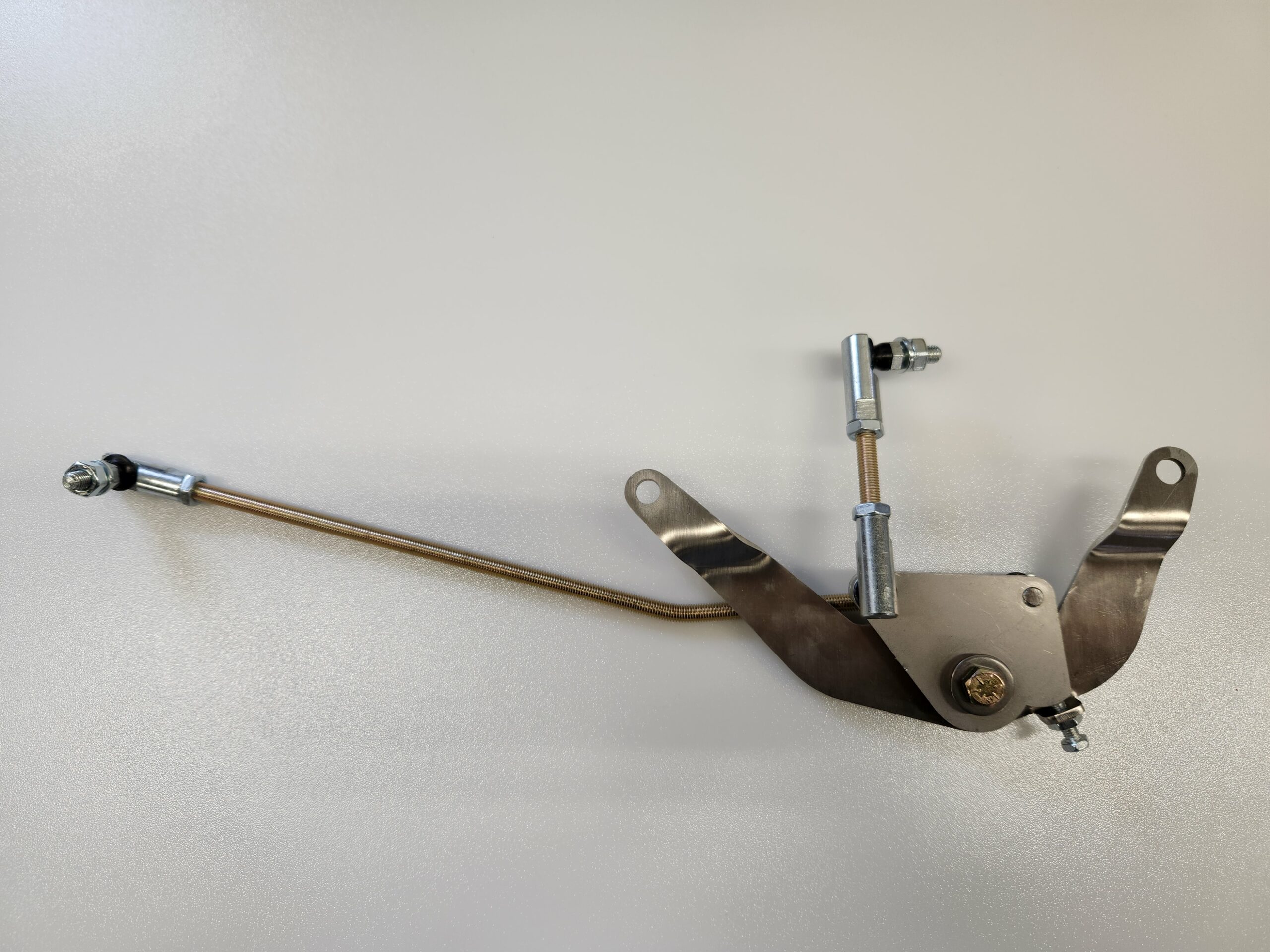 Accelerator Linkage Set, Dual Stromberg ↗
 Good Parts· $179.00 USD
Cooling 1
- 1977 Buick water pump pulleyBuick
Used as the reference point for making the matching custom crank pulley
In the shops Water Pump & Pulley ↗Moss Motors – Triumph TR6/TR250· $57.99 USD
 Water Pump Pulley (3/8" Groove) ↗Moss Motors – Triumph TR6/TR250· $0.00 USD
 Water Pump & Pulley (1/2" Groove) ↗Moss Motors – Triumph TR6/TR250· $56.99 USD
Suspension & Steering 1
- Borgenson steering shaftBorgenson
Used to modify the steering setup; leftover material reused for chromed spacers
Electrical 2
- GM alternatorGM
Mounted on driver's side with custom brackets to shorten engine length
- Ford Motorsport compact starterFord Motorsport
Fitted for extra clearance and to move the solenoid onto the starter instead of the fender
In the shopsPaco Motorsports 3" Suspension Lift Kit ↗Flyin' Miata· $289.00 USDIL Motorsport Competition Engine Mount Pair ↗Flyin' Miata· $149.00 USDIL Motorsport Competition Differential Bushing Pair ↗Flyin' Miata· $129.00 USD
Other 1
- Custom exhaust fabricationMuffler shop
Muffler shop to build the remainder of the header/exhaust run based on heater-tubing mockup
Photos
All 14 pictures in the write-up, in the order they were posted, shown from britishv8.org. A picture opens larger here, with the way through to the page it is on.
How it was done
Choosing the engine
Masters compared the BOP/Rover 215, small block Chevy 350, and Ford 302 Windsor on dimensions, weight, displacement, cost and parts availability. He found the Ford narrower and lighter than the Chevy, and even lighter than the stock TR6 six with aluminum heads fitted. He settled on the Ford Motorsport GT-40 aluminum head 302, rated at 320 HP.
Carburetion choice
Despite knowing fuel injection or a single carburetor would be more practical, he chose dual quad carburetors for the nostalgic look he remembered from his youth. To manage the extra fuel delivery he fitted a progressive linkage, so only two barrels operate around town and all eight open under full throttle.
Positioning the engine
He aimed to place the engine as far back and low as possible while keeping the stock battery location and enough legroom. The final position left the oil pan flush with the frame bottom, about an inch of fan-to-radiator clearance, and needed a small hood bulge of under two inches.
Clearing the steering rack
The Ford's long front crank pulley threatened to hit the TR6 steering rack. Rather than move the rack and risk bump steer, Masters had a machine-shop friend make a custom crank pulley, leaving about 3/4 inch clearance, enough to still change the fan belt.
Pulleys and alternator mounting
Using a spare 1977 Buick water pump pulley as a reference, he matched a custom crank pulley to it, then designed alternator mounting brackets to line everything up. He placed the alternator on the driver's side to shorten the engine's overall length, and later had the brackets chrome plated.
Building the motor mounts
He welded angle iron to tube steel, notched at 2.5 degrees to match the engine and driveline angle, then had a professional weld the joints. Rubber biscuit-type motor mounts from a street rod shop bolt these fabrications to matching steel tube weldments on the TR6 frame.
Reworking the oil pan
To avoid oil dripping onto the front crossmember during changes, Masters cut out the center of the dual-sump pan and fitted a fabricated sheet metal section so the front sump drains through the rear plug. This also added a quart or two of extra oil capacity.
Sorting the headers
Stock Ford shorty headers dumped into the firewall, so he bought block hugger headers instead, but they still needed about 3/4 inch more clearance and did not clear the body at the top. He cut the tubes to short stubs, mocked up the rest in heater tubing, and arranged for a muffler shop to fabricate the final exhaust run.
A summary in our own words. The full account, with all its detail, is the owner's: read it at britishv8.org ↗
Worth knowing
- Choose engine width and weight carefully - the Ford 302 proved narrower and lighter than a Chevy 350 alternative
- Avoid moving the steering rack to clear the crank pulley, since it can introduce bump steer; a custom pulley is a better fix
- Standard Ford shorty headers won't clear a TR6 firewall, and even block huggers need extra modification
- Reworking the oil pan to feed both sumps into one drain plug avoids mess and adds extra oil capacity
- Mocking up headers in cheap heater tubing before committing to custom fabrication saves costly mistakes